
THE GREAT CHRISTMAS CAROL CONTROVERSY
Updated: Dec 23, 2025

This will get extremely controversial, so I apologize ahead of time for bringing up such a sensitive topic, but…
…I must maintain my strong belief that the 1984 production of A Christmas Carol directed by Clive Donner and starring George C. Scott is the definitive and best version of the Dicken’s classic.
Now, I get it, right away, everyone will be wanting to counter with either 1992’s The Muppet Christmas Carol or 1951’s version with Alastair Sim. I no doubt agree that either of those are viable choices for best rendition of A Christmas Carol.

First of all, The Muppet Christmas Carol is, quite simply, marvelous. Besides having Michael Caine giving an excellent performance, and the Muppets themselves, and the lavish settings, it also has the sheer brilliance of Paul Williams providing the phenomenal music score. Plus, it effortlessly balances Muppet humor with emotional drama.

I only recently watched the 1951 version with Alastair Sims. I’ll admit, I was expecting an over-the-top performance by Sims of the moneylender—from a yelling and fuming Scrooge at the start, to a maniacally happy Scrooge at the end. I was surprised that Sims actually offered a fairly balanced and sincere performance on both ends. I also give the film credit for tackling some areas of the book no other cinematic production has attempted, such as Scrooge at Marley’s deathbed.

In my opinion, however, no version achieves the level of production, casting, screenwriting and performances that the 1984 version presents. Here is why I consider this the very best version of all:
1) The casting:
My goodness, besides George C. Scott in the title role, you have THE David Warner playing what I feel is the absolute definitive Bob Cratchet. You have THE Edward Woodward giving the most incredible performance of the Ghost of Christmas Present. Susannah York as Mrs. Cratchet (the mother of Superman, for goodness sake!). Beyond that, the casting of Fred, Tiny Tim and others is just impeccable.
2) The Writing:
No other version of A Christmas Carol that I have seen puts so much weight upon the themes of social responsibility and income disparity that seemed at the forefront of Dicken’s stories. Much of this falls most heavily on Edward Woodward’s shoulders as the Ghost of Christmas Present, and he takes command of that responsibility with his performance.
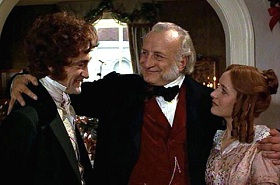
I also appreciate how, in this version, the relationship between Scrooge and his nephew Fred is much more strongly emphasized. It becomes one of Scrooge’s primary redemption points, not an ancillary one. It is Scrooge’s reunion with his nephew that is his final, most important recognition of his past sins. It represents his reconciliation not just with Fred, but with humanity.
3). The Setting:
Every scene just seems to exude the damp coldness, the dreary darkness of Victorian London, while still managing to give is a certain seasonal charm. There’s a willful lack of color in the settings around Scrooge that brightens by the end of the movie, all accomplished primarily through the setting and set pieces.
4) Quite simply, George C. Scott’s portrayal of Scrooge:
I cannot emphasize enough how brilliant I found his performance. As Scrooge, he almost never yells. He never throws tantrums. He isn’t coarse or growly or any of the typical performances you’ll often see in other actors’ performances. No, he is coldly rational. He is even-tempered and logical in his distain. He is such a realistic representation of someone who slowly, methodically rationalized his greed over his lifetime. His confusion and emotions as the ghosts visit him so perfectly shows a man whose entire ideology and worldview is slowly crumbling. Finally, as a redeemed Scrooge, other than his initial giddiness, the remaining moments with Scrooge is the same controlled emotion and even temperament, but this time through new eyes and a replenished soul, making his heartfelt statements to Fred and to the gentlemen raising money for the poor more emotional. Finally, his elation as he transforms his relationship with Cratchet is pure joy to watch.
So yeah, although the three versions I mentioned are all what I would consider the very best of Dicken’s classic Christmas tale, for my part, George C. Scott will always be my Scrooge, David Warner always my Bob Cratchet, and the 1984 version always my most favorite Christmas Carol of all.


Comments